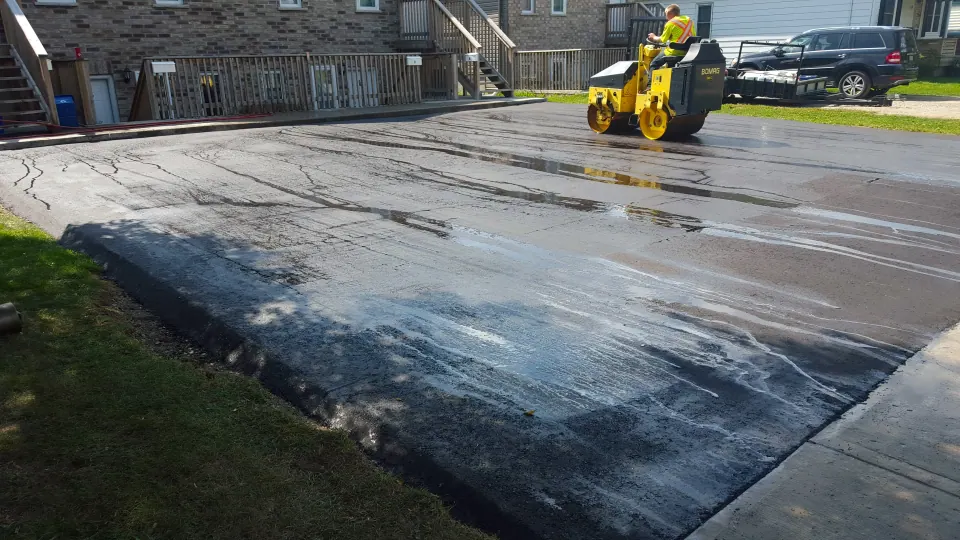
The short version: asphalt is not just the black layer you see. It is a load-carrying system made from prepared soil, compacted aggregate, one or more asphalt courses, drainage, and supported edges. A surface can look excellent on day one and still fail early if the system below it is weak.
What an asphalt pavement is made of
A typical driveway or parking area has three parts:
- Prepared subgrade. The native soil is shaped and compacted. Soft, wet, organic, or disturbed areas need correction before they are covered.
- Granular base. Crushed aggregate spreads wheel loads, creates a firm platform for compaction, and helps manage water.
- Asphalt course or courses. Hot-mix asphalt combines graded aggregate with asphalt binder. The mix is placed while hot and compacted to create density and stability.
Some projects add drainage improvements, geosynthetics, curbs, or more than one asphalt mix. Those are design responses—not upgrades that every site automatically needs.
The five controls on performance
1. Support
The surface cannot bridge indefinitely over a yielding base. Pumping at cracks, repeating depressions, or wheel-path movement can indicate a problem below the asphalt. The correct response may involve excavation and base repair, not another surface coat.
2. Drainage
Water reduces support, moves fine material, and expands when it freezes. That is why grading and outlets deserve attention before asphalt depth is discussed.
The Asphalt Institute’s engineering guidance recommends avoiding standing water and gives a general pavement cross-slope range of 1.5% to 3%. That is a useful design reference, not permission to direct runoff onto a neighbouring property, sidewalk, or building. Local grades and drainage obligations still govern.
3. Compacted thickness
A quote should state finished compacted thickness, not only loose depth before rolling. The correct pavement section depends on soil, base condition, traffic, turning, drainage, mix, and expected life. A passenger-car driveway and a loading area should not automatically use the same section.
Lift thickness also has to suit the aggregate in the mix. The Asphalt Institute notes that a compacted lift needs enough depth for aggregate particles to orient and density to develop. This is one reason a useful proposal identifies the mix and number of lifts rather than giving one unexplained total.
4. Density and construction temperature
Compaction is time-sensitive. Once the mix cools, achieving density becomes harder. Rain can cool the mat and interfere with compaction; paving on a wet or unstable base adds another risk. The contractor must coordinate mix temperature, haul time, paver speed, roller coverage, air temperature, and the temperature of the surface below.
Density is not something a homeowner can judge from colour. On larger or specified work, testing and documented acceptance criteria can make it measurable.
5. Edges, joints, and transitions
Edges need support, especially where tires turn or park close to the side. Transitions at garages, sidewalks, curbs, drains, utility covers, and existing pavement should be planned rather than improvised at the end of placement.
One lift or two?
O’Brien’s paving guide describes two-layer construction as an upgrade that can add thickness and strength. Its examples include a single residential lift of about 2 inches compacted, a light-duty two-layer system of 1.5 inches per lift, and a medium-duty system with a 2-inch base course and 1.5-inch surface course. These are company examples, not a specification for every site. Select the section for the support conditions, loading, mix, and project design.
Ask:
- What is the compacted thickness of each course?
- Which mix is used in each course?
- How will the joint between paving passes be handled?
- What prevents the edge from spreading or breaking?
- Does the proposed section change in high-load areas?
For a detailed design or public/commercial specification, use the project engineer’s requirements. General homeowner guidance cannot replace a site-specific pavement design.
When can new asphalt be used?
Fresh hot-mix asphalt gains stability as it cools. Do not hose a finished driveway to force an early reopening. That is different from the controlled use of water on roller drums during construction to limit asphalt sticking.
O’Brien’s asphalt aftercare instructions say to keep vehicles off new asphalt for at least 5–7 days in summer. Weather, loads, and the project instructions can require longer. Avoid stationary steering and concentrated loads while the surface is young or hot. A commercial lot needs its own traffic-opening plan; do not apply a residential timing example to every load.
What early quality checks look like
Before construction:
- Confirm drainage direction and final elevations.
- Identify soft spots, roots, utilities, covers, curbs, and transitions.
- Record the proposed base correction, asphalt mix, lift count, and compacted thickness.
- Clarify access, weather delays, cleanup, exclusions, and who obtains permits.
During and after construction:
- Water should have a continuous path to an appropriate outlet.
- Transitions should be deliberate and usable.
- Edges should be compacted and supported as specified.
- The finished surface should not show obvious roller marks, tearing, segregation, or widespread ponding.
- On tested work, keep density, material, and inspection records with the project file.
Maintenance starts with inspection
Keep drains and outlets clear, watch for cracks that admit water, and document areas that change from one season to the next. A treatment should match the distress:
- A sound surface with an isolated crack may need a localized seal or repair.
- A pothole needs failed material removed back to firm support; water or base problems may also need correction.
- Widespread fatigue cracking usually calls for structural investigation, not cosmetic coating.
- A stable pavement with surface aging may be a resurfacing candidate after repairs and drainage work.
O’Brien’s asphalt aftercare instructions exclude sealcoating in the first year. After that, assess the surface, drainage, treatment suitability, and contractor or product instructions. Sealcoating is an option for suitable existing asphalt, not a structural repair or an automatic annual purchase. The company’s basic maintenance guide also distinguishes condition-dependent maintenance from repairing failed pavement.
Questions worth putting in writing
- What will be removed, corrected, or left in place?
- How are soft areas identified and priced?
- What granular base material and compacted depth are included?
- What asphalt mix, lift count, and compacted thickness are included by zone?
- Where will water go after final grading?
- How are edges, joints, drains, curbs, and utility covers finished?
- What weather conditions pause the work?
- When may each vehicle type use the surface?
- What is excluded, and how are changes approved?
- What warranty applies, and what maintenance is expected from the owner?
Use the quote comparison worksheet to put answers from more than one proposal on equal terms.
Sources and further reading
- O’Brien Paving: Asphalt paving — company examples of single- and two-layer construction.
- O’Brien Paving: Asphalt tips — company opening, sealing, and aftercare instructions.
- O’Brien Paving: Basic maintenance — repair and maintenance options.
- Asphalt Institute: Engineering frequently asked questions — compaction, lift thickness, drainage, weather, opening, and sealcoating guidance.
- Asphalt Institute: Full-depth asphalt for private driveways — subgrade, placement, compaction, weather, and maintenance overview.
- Asphalt Institute: Repair of asphalt parking lots and driveways — distress causes and repair fundamentals.
Sources explain general principles. Municipal standards, project documents, manufacturer instructions, and site-specific professional advice take priority where they apply.