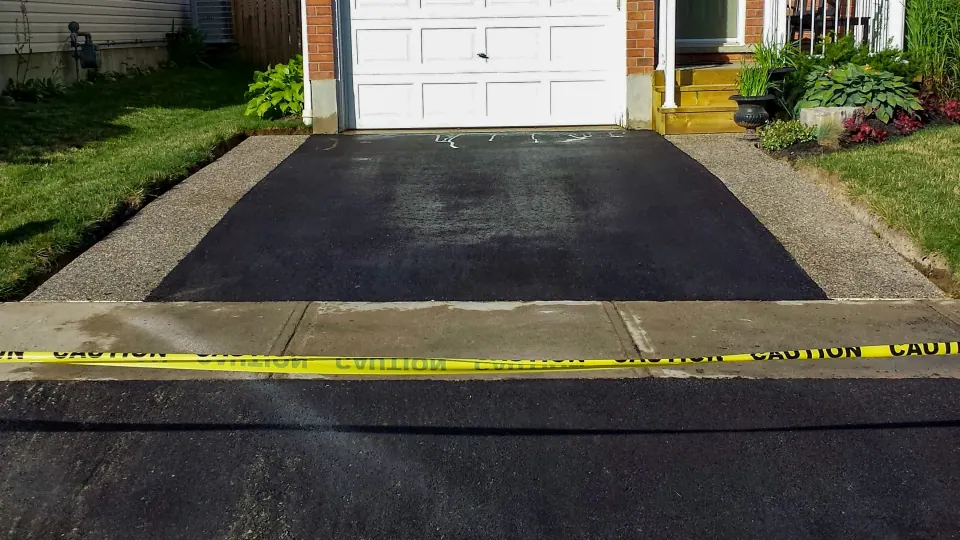
Start with the site, not the surface colour. A dependable driveway plan explains where water will go, what will support the pavement, how edges and transitions work, and what vehicles will use it.
Walk the property before requesting prices
Inspect during or immediately after rain if possible. Photograph and mark:
- standing water, roof discharge, and snow-storage areas;
- cracks, depressions, heaved panels, and soft shoulders;
- the garage threshold, sidewalk, curb, boulevard, and property line;
- water shut-offs, catch basins, cleanouts, utility covers, poles, and trees;
- narrow access for excavation, trucks, pavers, rollers, or concrete placement;
- gates, retaining walls, steps, and landscaping that must remain; and
- areas used by trailers, delivery trucks, recreational vehicles, or construction equipment.
This becomes the common starting point for every contractor. Without it, one price may assume a simple surface replacement while another includes excavation and drainage correction.
Decide what problem the project is solving
Write one short priority list:
- correct drainage or settlement;
- replace a failed surface;
- create or widen parking;
- improve an unsafe transition;
- reduce maintenance;
- change appearance; or
- prepare for heavier or different use.
Priorities affect design. Widening can involve municipal land, trees, parking rules, a curb, or a water shut-off. A low spot near a garage requires elevation planning before material selection.
Overlay, remove and replace, or repair?
An overlay may be worth investigating when:
- the existing pavement and base are broadly stable;
- settlement and fatigue cracking are limited;
- new elevations will still work at the garage, sidewalk, curb, and drainage outlets;
- reflective cracking is understood; and
- edges and transitions can be properly detailed.
Removal and reconstruction may be more appropriate when:
- widespread cracking points to structural movement;
- the base is contaminated, thin, wet, or inconsistent;
- drainage and elevation need significant correction;
- previous overlays have already raised the surface too far; or
- the driveway’s use is changing enough to require a different section.
Local repair may be enough when:
- damage is isolated;
- the surrounding surface remains sound;
- the cause can be corrected locally; and
- the appearance of a patch is acceptable.
Use the pavement damage guide to document symptoms before choosing a treatment.
Choose asphalt, concrete, or a combination
Asphalt 101 explains flexible pavement support and compaction. Concrete 101 explains slabs, joints, curing, and exterior exposure. The side-by-side comparison organizes lifecycle and construction tradeoffs.
On some properties, a combined solution is sensible—for example, concrete at a step, curb, drainage detail, or high-load pad with asphalt across the main parking field. The interface needs a planned elevation, joint, and drainage path.
Check local approvals before finalizing geometry
Driveway work entirely on private property can still meet a curb, boulevard, sidewalk, municipal tree, or utility. Widening or changing access can require approval.
- Kitchener requires a permit for widening or curb alteration within the municipal right-of-way.
- Waterloo asks residents to locate the water shut-off before paving and reserves curb-cut approval and work to the City.
- Cambridge requires an access permit for a new driveway access or alteration to an existing access.
- A connection to a Regional road can involve Region of Waterloo access and work permits.
Use the local driveway permit guide for current official links. Confirm requirements before contracting the affected work; municipal pages and fees can change.
What a useful driveway scope includes
Existing work and excavation
- measured area and project limits;
- material to remove and disposal responsibility;
- excavation depth or basis for determining it;
- treatment of soft spots, roots, unsuitable soil, and old fill;
- protection of the house, garage, utilities, sidewalk, curb, and landscaping.
Support and drainage
- granular material and compacted depth;
- method for correcting soft or wet areas;
- final elevations and intended water route;
- edge support and shoulder restoration;
- adjustments at utilities, drains, and thresholds.
Surface construction
For asphalt: mix, number of lifts, and finished compacted thickness by use zone.
For concrete: exposure requirements, slab thickness by use zone, reinforcement intent and position, joint plan, surface texture, and curing method.
Completion
- access and parking restrictions;
- weather-delay rules;
- cleanup and restoration;
- opening instructions for each expected load;
- warranty terms, exclusions, and owner maintenance.
Compare quotes without losing the details
Move every proposal into the same checklist. Mark an item included, excluded, allowance, or not stated. Ask for clarification in writing instead of assuming that two short descriptions mean the same work.
Price differences often come from:
- different measured areas;
- removal versus overlay;
- excavation and disposal volume;
- base correction assumptions;
- pavement section and material;
- drainage or utility adjustments;
- access constraints and handwork;
- curbs, borders, steps, or restoration; and
- warranty and testing requirements.
Open the print-friendly quote comparison worksheet to line these up.
What to expect during construction
Before mobilization, confirm vehicle access, pedestrian access, material staging, weather communication, pets, gates, and where removed material will travel.
During work, avoid directing the crew minute by minute; use the agreed scope and a named point of contact. If hidden conditions change the plan, document the condition, proposed response, price, and schedule effect before extra work proceeds.
At completion, walk the project before equipment leaves. Review drainage intent, transitions, edges, surface finish, cleanup, opening instructions, and outstanding restoration.
Aftercare is material- and project-specific
For asphalt, O’Brien’s aftercare guide calls for at least 5–7 days without vehicles in summer and no sealcoating in the first year. Follow any longer project-specific protection period, and avoid sharp stationary steering or concentrated loads while the surface is hot and young.
For concrete, O’Brien’s aftercare guide calls for at least seven days without vehicles in summer, longer for cooler or damp conditions and heavy loads. Avoid de-icing salt in the first and second winters where possible. “Dry-looking” is not the same as fully cured or ready for every load.
For either material, keep water moving, avoid damaging edges, and photograph early changes while warranty and construction records are easy to find.